









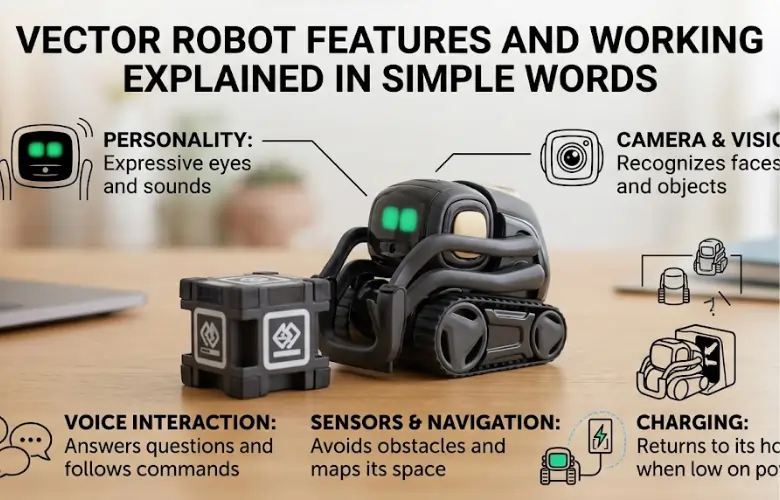
The vector robot is a miniature robot that uses AI and interacts with people using verbal communication, body language, and emotional gestures. It integrates artificial intelligence, sensory capabilities, and robots to provide an immersive experience that seems to be a digital pet rather than a piece of equipment. The intelligent robot recognizes faces, understands vocal instructions, and explores the environment independently. The vector robot is popular for educational and recreational purposes and studying advanced AI technology. This new age robot is part of the consumer robotic revolution, where machines become interactive, engaging, and emotional companions.
What is Vector Robot and Why It Is Important in AI Technology
The vector robot is a small autonomous robotic system that uses artificial intelligence, sensors, and cloud computing to understand its environment. It processes information in real time and responds based on what it sees, hears, and detects around it. In addition, it does not rely completely on manual control because it is designed to operate independently in many situations.
Furthermore, the robot can recognize faces, remember users, and respond in a personalized way. This means that over time, it becomes more familiar with people it interacts with regularly. Because of this learning ability, it creates a more natural and engaging experience for users. Unlike basic smart devices, it does not only execute commands; instead, it adapts its behavior based on interaction patterns.
In addition, it represents an important development in consumer robotics because it shows how artificial intelligence can create emotional and social interaction between humans and machines. Therefore, it plays a key role in understanding the future of AI-driven companions.
Vector Robot Features and Smart Functional Capabilities
The vector robot features are designed to create a balance between intelligence, interaction, and entertainment. It includes multiple sensors, a camera, microphones, and motion systems that work together to create a smooth user experience.
One of its most important capabilities is voice interaction. It listens to spoken commands, processes them using artificial intelligence, and responds in real time. This makes communication simple and natural. In addition, it can answer basic questions and react to simple instructions, which improves its usability in daily environments.
Another key feature is facial recognition. The robot can identify people it has seen before and remember them. Because of this, it provides more personalized responses over time. This makes interactions feel more meaningful and less robotic.
Moreover, the robot includes autonomous movement capabilities. It can move across flat surfaces using wheels while avoiding obstacles. It uses sensors to detect edges and objects, which helps prevent accidents. As a result, it can safely explore its environment without human control.
How Vector Robot Works Using Artificial Intelligence Systems
The vector robot operates using a combination of hardware sensors and artificial intelligence software. When a user speaks to it, the microphone captures the voice and converts it into digital data. This data is then processed using cloud-based AI systems that analyze the meaning and context of the command.
After processing, the system generates a response and sends it back to the robot. The robot then delivers the response through sound and animated facial expressions. This creates a natural and interactive communication experience between the user and the machine.
At the same time, the robot uses a built-in camera to observe its surroundings. It can detect faces, identify objects, and track movement in real time. In addition, infrared sensors help it measure distance and avoid obstacles. Because of these systems, it can move safely and respond intelligently to environmental changes.
Moreover, machine learning plays a major role in improving its performance. As users interact with it more frequently, it begins to learn patterns, preferences, and behavior styles. As a result, its responses become more accurate and personalized over time.
Real-World Uses and Applications of Vector Robot
The vector robot is mainly used for educational, entertainment, and beginner-level artificial intelligence learning purposes. It is not designed for industrial automation or advanced professional tasks. Instead, it focuses on interaction and learning experiences.
In educational environments, it helps students understand how artificial intelligence works in real-world applications. For example, they can observe how voice recognition, facial detection, and movement control work together in one system. This makes complex AI concepts easier to understand.
In home environments, it acts as a small interactive companion that responds to voice commands and explores surfaces. It provides entertainment through movement and expressions, making it enjoyable for everyday use. Many users place it on desks or tables where it interacts throughout the day.
In addition, it is used as a learning tool for beginners in robotics. It helps users understand how machines process information and make decisions based on data. Therefore, it plays an important role in introducing artificial intelligence to new learners.
Advantages of AI Companion Robotics Systems
One of the biggest advantages of this system is emotional interaction. It does not behave like a simple machine but reacts in a way that feels expressive and engaging. Because of this, users feel more connected to the robot.
Another advantage is autonomy. Once activated, it can operate independently without constant control. It moves, responds, and manages charging on its own, which makes it easy to use in daily life.
In addition, it provides strong educational value. Users can observe artificial intelligence in action instead of only reading about it. This practical experience improves understanding of AI concepts.
Moreover, the system adapts over time. It learns from user interactions and improves responses based on behavior patterns. As a result, the experience becomes more personalized and intelligent.
Limitations of Vector Robot Technology
Although the system is advanced, it still has some limitations. One major limitation is battery life, which is relatively short and requires frequent recharging during active use.
Another limitation is dependence on internet connectivity. Some features rely on cloud-based processing, so performance may be limited without a stable connection.
In addition, it is not designed for professional or industrial applications. Its main focus is interaction, learning, and entertainment rather than productivity tasks.
However, these limitations are balanced by its strong focus on personality-driven interaction and educational value.
Technical Overview and System Performance
The system is built using compact robotic hardware that includes a camera, microphones, sensors, and motion components. These components work together to create a responsive and interactive experience.
The movement system allows smooth navigation on flat surfaces while maintaining stability. Sensors detect obstacles and edges, which helps prevent accidents.
In addition, the processing system handles voice recognition, facial detection, and environmental mapping in real time. This ensures fast and accurate responses during interaction.
Battery management is fully automated through a docking system. When power is low, the robot returns to its charging station without user assistance. Therefore, it remains functional with minimal effort.
Future of AI Companion Robots and Intelligent Systems
The future of AI companion robotics is expected to grow rapidly as artificial intelligence continues to evolve. Future systems will likely include more advanced emotional intelligence, better communication abilities, and longer battery performance.
As AI becomes more advanced, robots will better understand human emotions, tone, and context. This will make interactions more natural and meaningful.
In addition, integration with smart environments will increase. Robots will be able to connect with home devices and digital systems more effectively. As a result, they will become more useful in daily life.
Overall, AI companion robots represent a major step toward a future where machines are not just tools but interactive partners in human life.
- Also Read. Bucklers Hard: Complete Travel Guide History Attractions and Things to Do in Hampshire England
(FAQs)
1. What is a vector robot used for?
The vector robt is mainly used for education, entertainment, and learning about artificial intelligence. It helps users understand how robots can recognize faces, respond to voice commands, and move autonomously in real environments. It is especially useful for beginners who want to explore robotics in a simple and interactive way.
2. How does Vector Robot work?
The robot works using artificial intelligence, sensors, a camera, and cloud-based processing. It listens to voice commands, analyzes them, and responds with appropriate actions or speech. It also uses visual recognition to understand its surroundings and interact more naturally with users.
3. Is Vector Robot good for learning AI?
Yes, it is a helpful tool for learning basic AI concepts. Students can observe how machines process information, recognize people, and react to commands. This makes complex ideas like machine learning and robotics easier to understand in a practical way.
4. Can Vector Robot recognize people?
Yes, it can identify and remember faces using built-in facial recognition technology. This allows it to personalize interactions and respond differently to familiar users over time.
5. Does Vector Robot need internet to work?
Yes, it requires internet connectivity for many of its advanced features. Without it, some functions such as cloud-based AI responses may be limited or not available.
Conclusion
The vector robot stands out as a remarkable development in consumer AI and robotics. This machine blends motion capability, voice commands, face recognition, and emotion detection in a small yet smart package. Even though it does not specialize in productivity activities, it is great in fields such as education and entertainment. It allows individuals to learn more about how AI functions in the real world and see what possibilities lie ahead in terms of human-machine interaction. With advancing technology, robots of this nature will become even smarter and more sophisticated in the future.


