









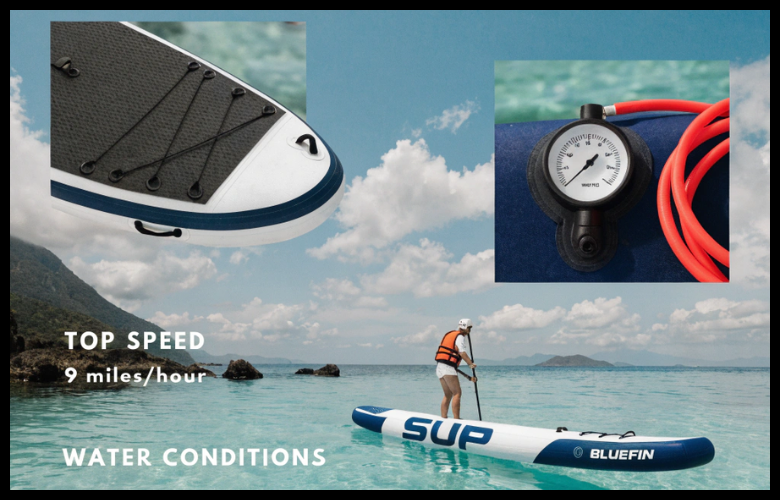
One of the best-selling inflatable stand-up paddle boards is the bluefin paddle board. This is due to the fact that it provides high levels of stability, durability, and usability, thereby making it perfect for usage in lakes, rivers, and coastal regions. The reason why many buyers go for this paddle board is that it comes with everything that one needs to start using it immediately. Besides being wide and providing more balance when paddling, the board is highly durable and can withstand the effects of regular usage for a long period of time.
What is a Bluefin Paddle Board and how it works
A Bluefin inflatable SUP is built using drop-stitch technology, which connects the top and bottom layers of the board with thousands of internal threads. When the board is inflated, these threads keep it extremely tight and rigid, allowing it to perform similarly to a hardboard. Most models are inflated between 15 and 18 PSI, which gives them strong structural stability on water while still remaining portable when deflated.
The main purpose of this design is to create a safe and stable platform for paddlers of all skill levels. The wide structure helps beginners maintain balance easily, reducing the chances of falling. This makes learning paddle boarding less stressful and more enjoyable, especially for first-time users who are still building confidence on water.
Key features and construction quality
The bluefin paddle board is built with durability and practicality in mind, making it suitable for long-term recreational use. It is made using reinforced PVC material that helps resist punctures, scratches, and general wear and tear. Inside the board, drop-stitch fibers maintain shape and firmness when fully inflated, ensuring it can handle different weights without losing stability.
One of its strongest advantages is that it comes as a complete kit. Most packages include a paddle, high-pressure pump, safety leash, repair kit, and a large carrying backpack. Some models also offer a kayak conversion seat, which allows users to switch between standing and seated paddling. This adds versatility and makes the board suitable for different types of water activities.
Performance on water conditions
In real-world use, a Bluefin SUP is designed to focus more on stability and control rather than speed. It performs best in calm environments such as lakes, slow rivers, and protected coastal areas. The wide shape ensures better balance, which is especially helpful for beginners who are still learning how to control movement on water.
The fin system underneath the board improves tracking, helping it move in a straight line with less effort. However, because of its wider structure, it is not designed for racing or high-speed paddling. Instead, it prioritizes safety, comfort, and ease of use, making it ideal for relaxed recreational sessions rather than competitive sports.
Advantages and disadvantages
Advantages include excellent stability, strong construction quality, and a complete beginner-friendly package. It is suitable for families, casual users, and first-time paddlers. It also offers good weight capacity and is easy to store when deflated, making it practical for home use. The included accessories add significant value and convenience.
On the downside, it is heavier than premium performance boards, which may make transport slightly less convenient. It is not suitable for racing or advanced speed-based paddling. It can also feel bulky when packed, and its performance in strong wind conditions is limited compared to narrower touring boards.
Who should use this paddle board
The Bluefin paddle board is ideal for beginners who want a safe and stable introduction to paddle boarding. It is also a great option for families who want to enjoy outdoor water activities together. Casual paddlers who prefer relaxed sessions on calm water will find it especially suitable.
It is also a good choice for users who want convenience, since everything is included in one package. However, advanced paddlers or athletes who focus on speed, touring, or long-distance performance may prefer specialized boards designed for higher efficiency.
How to choose the right model
Selecting the right board depends on several important factors such as weight, experience level, and intended usage. Wider boards provide better stability, while longer boards offer improved straight-line tracking and smoother movement over distance. Weight capacity should also be checked to ensure safe and comfortable use.
It is also important to consider where the board will be used most often. Calm lakes and rivers are ideal for standard models, while slightly choppier waters may require more stable designs. Some users may also prefer models with kayak conversion options for added flexibility.
Maintenance and care guidelines
Proper care is essential for extending the lifespan of any inflatable paddle board. After each use, especially in saltwater, the board should be rinsed with clean fresh water to remove salt, sand, and debris. This helps prevent long-term material damage and keeps it in good condition.
The board should always be completely dry before being folded and stored. It is best kept in a cool, shaded area away from direct sunlight to avoid heat-related damage. Regular inspection of valves, seams, and surface areas is also important to detect air leaks early. With proper maintenance, the board can remain in excellent condition for many years of regular use.
Comparison with other paddle boards
Compared to many entry-level inflatable SUPs, this type of paddle board offers better stability, stronger materials, and a more complete starter package. Budget boards may be cheaper, but they often lack durability and rigidity, which affects performance and safety.
Premium touring or racing boards offer higher speed and better efficiency, but they are less stable and more difficult for beginners to control. This board sits in the middle category, offering a balanced combination of stability, usability, and durability. This makes it a practical option for recreational users who want reliability without complexity.
(FAQs)
1. What is a Bluefin paddle board used for?
A Bluefin paddle board is mainly used for recreational water activities such as paddling on lakes, calm rivers, and sheltered coastal waters. It is designed for beginners and casual users who want a stable and easy-to-use inflatable SUP for fun, fitness, or relaxation on water.
2. Is a Bluefin paddle board good for beginners?
Yes, it is considered one of the best options for beginners because of its wide shape and strong stability. It helps new users maintain balance more easily, reducing the learning curve and making paddle boarding safer and more enjoyable.
3. How long does it take to inflate a Bluefin paddle board?
On average, it takes around 5 to 10 minutes to fully inflate a Bluefin paddle bord using the included manual pump. The time may vary depending on the model and the user’s pumping speed, but it is generally quick and manageable.
4. Can a Bluefin paddle board be used in the sea?
Yes, it can be used in calm sea conditions such as sheltered bays and light coastal waters. However, it is not designed for rough waves or strong currents, as it performs best in stable and flat water environments.
5. What weight can a Bluefin paddle board hold?
Most Bluefin paddle bords can support a significant weight capacity, typically suitable for one adult and additional gear. Exact limits depend on the model, but they are generally strong enough for users of different sizes and even light tandem use.
Conclusion
From the above discussion, it is clear that the bluefin paddle board is a reliable and friendly product for those looking into purchasing one for themselves. It has great qualities regarding durability and ease of use, and thus will be perfect for both beginners and families. However, it should not be used by professionals due to its lack of speed and other features necessary for racers. Nonetheless, it is ideal for use on flat water. The fact that comes with the entire kit is an added advantage.


